


Review of ‘RawMantiSch’ (2025) by Wave Tank
Wave Tank’s 8-track album, RawMantiSch (2025, Bandcamp) is a clever manipulation of faders and buttons, employing as best as it can the capabilities of a number of different synths and vocal filters. Without overloading the songs, the compositional approach is based on simplicity, repetition and imagination. In this way, loud, weird and monotonous bass lines, for instance, stay interesting and fresh throughout the songs, allowing beats and rythmic patterns to create the required atmosphere for the story that is communicated. In the end, whether inspired by personal obsessions (track No 3 – Christian Death’s, Dogs, and Dead Kennedys’, At My Job), or referencing personal favourites (track No 7 – Chris & Cosey’s, In Ecstacy), the Neo-Romantics of the 80s, the punk ethos and the goth rock aesthetics introduce a feeling of urgency to take action. But why take action and how is it encouraged?
The title of the album, RawMantiSch, makes immediately a connection with ‘romanticism’. Romantisch is the German word for ‘romantic’. In eighteenth- and nineteenth-century Europe, the Romantic movement in the arts was associated with heightened emotional expression and nature. It was a product of rural communities, valuing the countryside over the city. For the romantics, the city was unnatural, a monster.
However, although the title does sound like ‘Romantisch’, it uses instead the word ‘raw’. Raw, of course, can mean raw or uncooked food, as it has come straight from nature. Moreover, ‘raw’ can be understood as raw emotions – i.e. feelings which are unfiltered by civilisation and societal norms, and they can often be seen as honest, frank and realistic. Raw feelings sometimes are valued more, as ‘raw’ is also used to mean strong or intense.
Wave Tank’s song Human Memories is exactly about this. It looks back at earlier stages of human life on earth to bring our attention to what valuable things we have lost in the name of extreme urbanisation, digitalisation, human-to-human connection, increased separation from nature, and more:
- ‘Do you remember the colours and the sunset?’, ‘Do you remember the rain?’, ‘Do you remember the trees?’
Similarly, Do You Want Time to Get Slow is a direct attack to city life:
- ‘Do you feel time getting slow when you walk away this modern city?’, ‘All puppets want you to work, to work in high speed.’, ‘Do you want to break the clocks?’
At the same time, the Romantic movement was also a reaction to the Enlightenment, which sought to revive the classical idea of the self-governed people in the ‘free’ city, and more specifically, the ancient cities of Athens and Republican Rome. It therefore attacked both the Enlightenment’s fundamental principles of science, reason and logic, and the means with which it represented itself, which was none other than the classical tradition, with its focus on balance, harmony, symmetry and the logical organisation of an arrangement. The Romantic movement proposed culture instead of science, emotions instead of reason, and imagination instead of logic. [i]
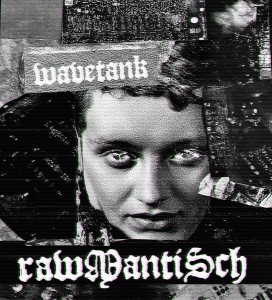
The album cover of RawMantiSch (2025) also disregards logic. Disjointed uneven patches of abstract patterns surrounding what looks like a Weimar photographic portrait for a movie poster or an avant-garde magazine. Using a glitch-art technique, which itself reminds Dada collages and magazine covers for mid-twentieth century publications, the black-and-white photographic portrait, whether AI generated or found, is defaced in a manner that reminds the CoBrA artist Asger Jorn’s artistic vandalisms. [i] The cover of RawMantiSch (2025), then, also plays with our memories of the black-and-white era and hand-made typography.
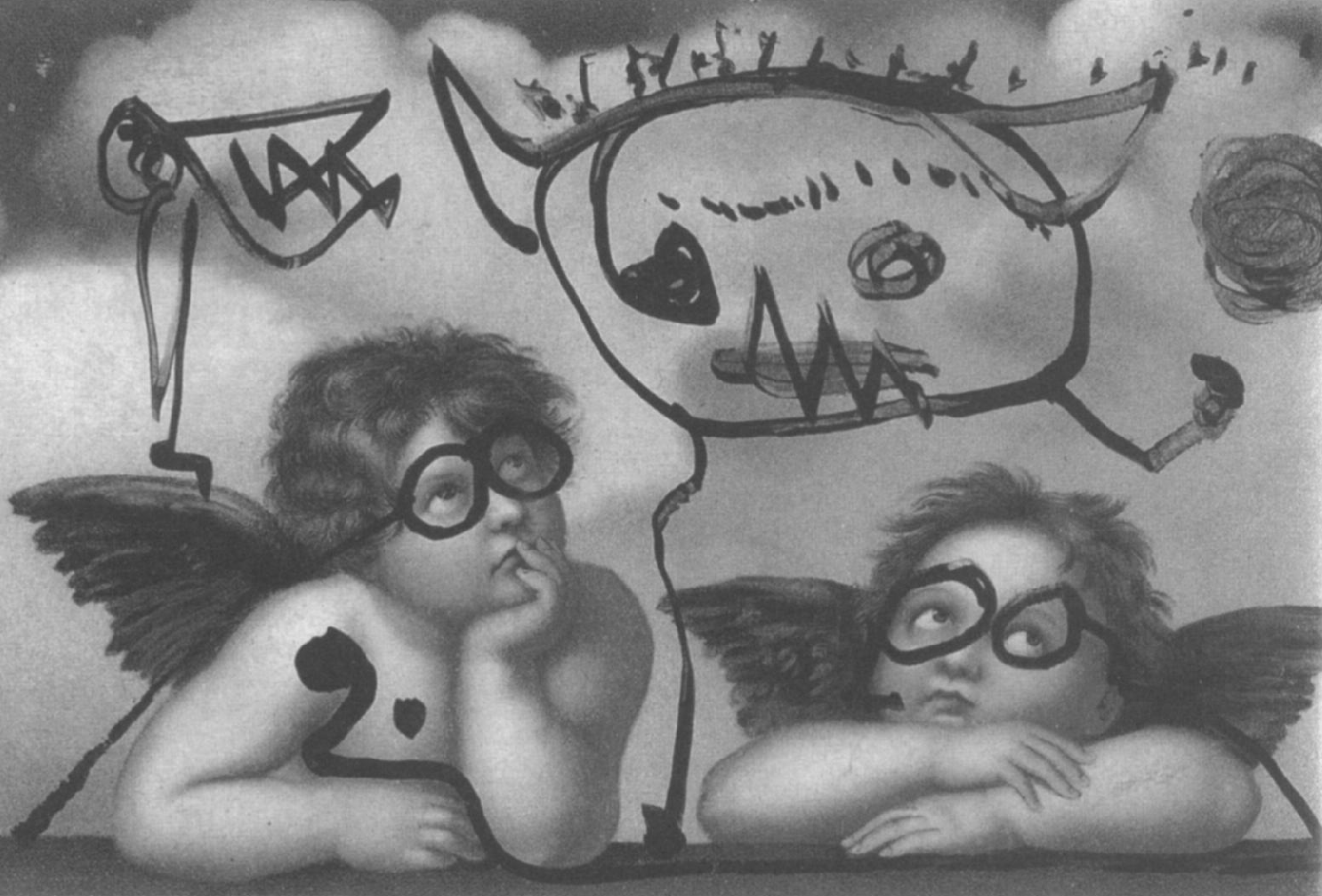
Asger Jorn, 'Untitled' (Raphael's Angels), c. 1949
Memories, of course, in the sense of history, tradition and ancient religions, were at the heart of the Romantic movement’s political ambitions. After all, Romanticism coincided with the rise of nationalism. With the use of visual prompts, which often included paintings depicting extreme natural phenomena or historical landmarks of local significance, memories aimed at stirring the viewer’s emotions. These emotions could be either positive, such as extreme admiration, intense joy, or rapture – when seeing, for instance, a vast area of green land with spectacular waterfalls and impressively colourful plants – or negative, such as the deep fear felt by seeing strong blasts of wind gusting through a forest, uprooting trees and damaging buildings.
In music, too, the Romantic composer would use extreme dramatization to disturb the traditional sense of balance and harmony, which the Enlightenment valued so much, using dynamic colouring and extreme atonality. For example, the late-Romantic composer Richard Strauss, in his opera Elektra (1909), an adaptation of the ancient Greek play Electra (c.420-414 BC) by Sophocles, the focus is on the psychological world of the protagonist, Elektra, not on the construction of a clear story. The music is deliberately loud, employing more than a hundred musical instruments, and repetitive.
If this sounds like the early-1990s grunge or shoegaze movements, which focused specifically on the atmosphere, it is because grunge and shoegaze artists were also interested precisely in the psychological effects created by music, and in this case, guitar noise. After all, when the electric guitar amplifier is turned to the maximum setting to create the greatest distortion possible, the words are obscured and difficult to decipher.
Romanticism’s capacity to move the masses emotionally was very quickly exploited by the elites, who were able to work on people’s imagination using the appropriate symbols, myths and memories to inspire irrational reactions. For example, in the same way that an image of powerful sea waves hitting with immense force the rocks in the seashore could inspire feelings of fear, grief, anxiety and despair, an image of one’s homeland depicting a local site of national importance could inspire love for the nation. Romantic art helped create in the minds of the masses a typical picture of the nation. By stressing some common physical characteristics and suppressing differences, the nation was made to look homogenous. [i]
More importantly, this national image showed that a nation was distinct from its neighbours, so its plants and trees had to be made to look different from those outside its borders. The elites had discovered now a way to convert the public to the national idea. The Romantic artist helped them make the abstract idea of the nation visible. National forests, lakes, rivers and plants could become instantly recognisable, and the nation’s borders clearly graspable by being recorded with archaeological accuracy. [i]
Wave Tank also address this issue. The song Facing the Rich People is about these elites, those individuals who are above the politicians. In your country, wherever you are, you have an example of this. A media baron, a biopharma mogul, an arms dealer in the legitimate defence industry. You read about them every day, and you know them, but you don’t know they are the local elites governing your country. You think the politician you voted for to represent you takes decisions about you. The role of the elites in what we call ‘democracy’ and their actions are invisible. Or do you see them?
Perhaps, invisible to many of you is also the so-called brain behind Wave Tank, who has been making music since 2007, slightly in the background and in disguise, experimenting with different musical genres and styles within the wider alternative scene and with a DIY approach. Some might have heard the name Mr.XIII in relation to this band, or in relation to projects such as VHSGhost, Background Projection, Galaxia Obscura, Urban Seance, Bröckensbectrwm, and more. Some might also know him as DJ Tumult (real name Petros) and as a frequent clollaborator of Tango Mangalore, as a member of Gematos Arachnes Re File!, The Cyclothymics, Akiraja, Κωμωδία Θανάτου, Εμφιαλωμένοι Εραστές, Abra Macabra, Mani Deum, and other bands, or as the person to whom Eddie Dark’s 2023 album is dedicated.
Lastly, RawMantiSch (2025) doesn’t cost any money. It wasn’t made to be sold.
- Chris Salatelis